A former drill instructor leads a new crew in painting
At 16 years old, Jameson Griffis knew he had to get out.
Growing up, he was raised by a mother who worked as a nurse, surrounded by music and blue-collar work. But when she remarried and moved him to Atlanta, Jameson was plunged into chaos.
“They were drinking pretty bad,” Jameson remembers. “I grew up in an alcoholic home.”
By 10th grade, he’d had enough. Jameson dropped out of high school, packed his things, and moved out.
He didn’t have much of a plan. No vehicle or place to live. But at least he was out.
“My journey to the Marines is a little bit more difficult,” Jameson says, “being homeless there for a while and getting my feet up under me.”
On His Own
Jameson got lucky. He stumbled into a job at a local business that needed help. Across the street was a hotel.
Jameson talked to the owner and said “Hey, if I can stay at your hotel, I’ll give you my first check as soon as it comes.”
the owner took the deal.
Jameson stayed for six months, saving money, eating cans of chili and soup. That’s when he decided to join the Marines.
When Jameson showed up at his local recruiting station, he left disappointed. The recruiter told him he needed to get a GeD.
“The Marines are not gonna let you join without that,” the recruiter said.
Jameson wasn’t going to take no for an answer. He borrowed a bunch of books to teach himself all the material he didn’t learn in high school: advanced algebra, science, everything. Within the year he passed the GeD with flying colors.
When Jameson marched back to the recruiter with GeD in hand, he was told he wasn’t quite ready. He needed at least a semester of college.
So Jameson went to Georgia Military College.
“And the day that I finished my finals was the day that I left for boot camp,” Jameson says. “I literally had a handwritten note from the teacher saying what my grades were and that I passed.”
Brothers In Arms
Boot camp wasn’t intimidating to Jameson the way it was for his classmates.
He had plenty of experience working on farms and doing hard labor, so physical work was nothing new. Getting yelled at by the drill instructors would be nothing compared to what he’d been through at home.
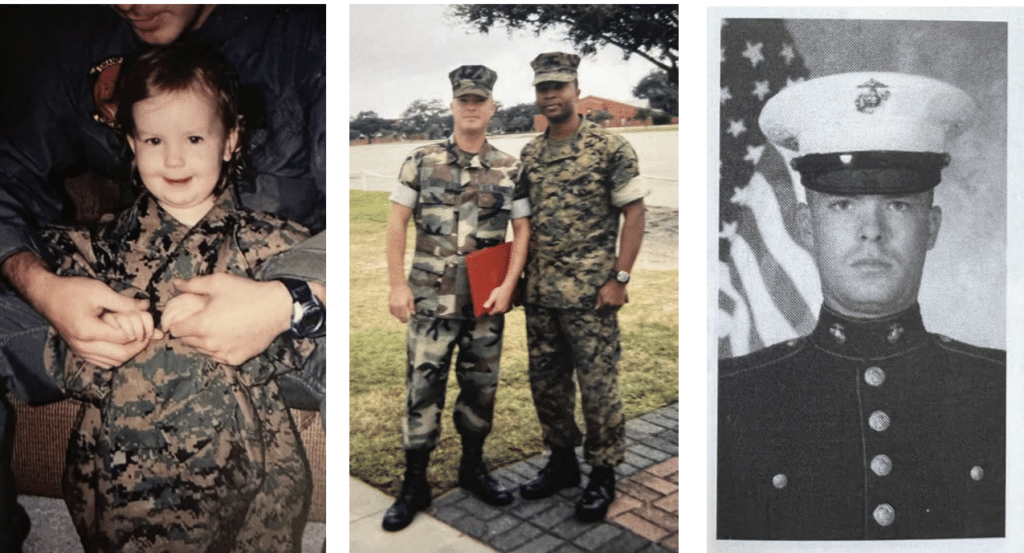
Best of all, Jameson wasn’t going in alone. He enlisted alongside his brother, though they kept it under wraps in the barracks. They ended up in the same platoon, sharing bunks and moving through the early weeks of training together.
their shared journey wouldn’t last. His brother shattered both ankles during training and was pulled from the platoon. He would eventually find his own way back into uniform through the Navy, but at that moment, Jameson was on his own.
He graduated and moved into aviation power generation soon after. Ironically, Jameson was on his way to becoming a drill instructor himself.
Making Marines
Once he was on the other side of the whistle, Jameson learned that being a drill instructor is actually harder than being a recruit.
When the recruits marched, their drill instructor ran. His every movement was watched for signs of weakness.
“You’ve always got to be on top of your game. You can’t show you’re tired. You’ve got to always be at 100%,” Jameson says. “the good thing is, you’re making Marines.”
For a time, Jameson served in search-and-rescue units, training for ocean operations along the South Carolina coast. The work exposed him to the thin line between life and death in a way he hadn’t experienced before.
More than once, Jameson nearly drowned. It is a feeling that never really leaves you: the burning in your lungs, the panic of not being able to catch your next breath. those moments of terror carve a deep scar that sometimes doesn’t fully surface until years later.
Then his health failed.
Losing Breath
Jameson found himself feeling fatigued. Physical activity left him winded.
He went to a doctor who diagnosed him with sarcoidosis, an inflammatory disease in which the immune system overreacts and forms granulomas, usually in the lungs.
VA and military health studies have shown an elevated incidence of sarcoidosis among veterans, particularly in the Navy, in the Marines, and in aviation-related roles.
It’s not fully understood why, but the leading hypothesis is occupational exposure to jet fuel, exhaust, or other environmental contaminants.
Aggressive doses of corticosteroids sent the disease into remission for Jameson. He returned to the drill field as an instructor, only to experience a relapse that left him unable to run the drills.
In 2006, unable to recover, Jameson medically retired from the Marines. The career he intended to last for decades ended prematurely.
“My goal was to do 30 years. I wanted to be a judge advocate,” Jameson says. “That did not work out.”
Life After Service
Despite his illness, Jameson wasted no time entering the job market. He went to work at Caterpillar managing massive electrical systems and complex projects.
Next he became national sales manager for Peterbilt. Then he moved to Bridgestone, managing some of the largest commercial accounts in the country.
On paper, he had all the trappings of success. Inside, he was struggling.
The turning point came when he walked into the VA and asked for help.
There, he learned about post-traumatic stress disorder and came to understand that talking about it wasn’t a weakness.
Through his self-discovery he realized that he craved autonomy. After years of managing organizations for others, Jameson wanted to build something for himself.
Initially, he and his wife looked at buying an existing operation, focusing on home service companies where strong leadership and systems could make an immediate difference.
But he was tired of inheriting other people’s problems. He wanted a fresh start.
He was Googling information on standard operating procedures and industry standards when he discovered the PCA. As a veteran, Jameson qualified for the Behr scholarship program, which covered the cost to attend the PCA’s residential and commercial conferences.
Now, Jameson has a clear vision for his future. the next phase includes building W-2 crews, refining SoPs, and standing up multiple two-person teams.
Beyond the numbers, Jameson sees a larger opportunity: helping veterans find a path forward.
“Entrepreneurship is something that all service members should look at, especially in the service industries where the barriers to entry are low,” he says. “PCA is an outstanding resource to get your feet under you, to get started, and to help you grow your business.”